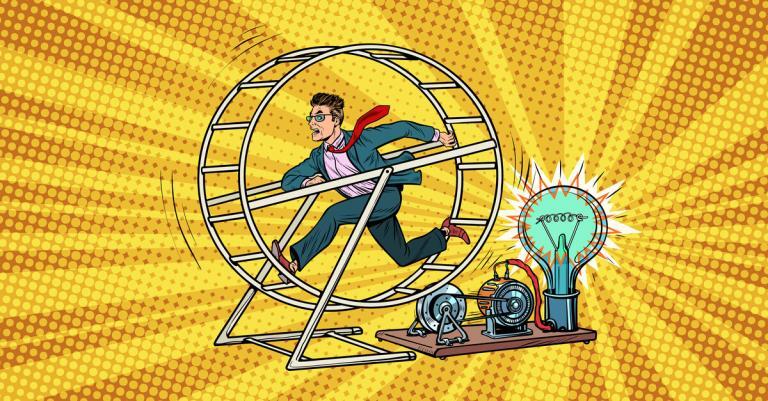
Ever beat yourself up for putting off all those things on your eternal never ending to-do list? Maybe writing that report, reading those industry updates, having that difficult conversation, mowing the lawn or calling your mother?
You are not alone! It’s called “procrastination”
What is procrastination
Procrastination is the avoidance of doing a task that needs to be completed. When you procrastinate, you may put off actions until the very last minute, perform them late or never do them at all. This can lead to feelings of guilt, inadequacy, depression and self-doubt. On top of that, you also waste a lot of time and energy. Very annoying and totally inefficient!
Procrastination is a very common behaviour. I dare say that we all (including me!) procrastinate from time to time. It’s a topic that is raised by many of my life coaching clients.
Are you just lazy?
I have plenty of high-achieving clients who feel bad about their procrastination. Sometimes they even call themselves “lazy”, despite all the success they have already created in their life. I always tell them that I do not believe there are lazy people. “Lazy” is just an unhelpful label with a negative judgment that we attach to certain behaviours. It masks the fact that there is always a perfectly understandable cause for procrastination.
Why do you procrastinate?
Let’s have a look at the possible reasons for procrastination. Whilst there are many, most of them fall into the following two groups. Let’s discuss them here in the context of your work:
Reason 1: You simply don’t care enough
It may be that you simply do not care enough about the tasks you have to do. You may not enjoy performing them, or you don’t believe in their benefits. They are simply not a priority for you.
That’s an important clue for your self-management in life.
We are always most organised, reliable and productive in relation to actions that matter to us. On the other hand, we are more likely to procrastinate if the items on our to-do list don’t matter to us. Makes sense, doesn’t it?
If your job requires you to perform a significant amount of work that you don’t care about, it’s time to ask yourself whether you are in the right position. Just think of all the effort and wasted energy that are required to motivate you to perform tasks that you resent. If you do this over a long time, it will probably frustrate and wear you down. You may even suffer burnout or depression.
Life is too short to waste it in a job you don’t enjoy. Just imagine how it would feel to have a job that allowed you to perform tasks that mostly inspire you and that help you move forward on your chosen mission in life.
If you are not ready or able to change your job at this point in your life, then you still have a few other options to consider:
- Delegate: Can you delegate or outsource the activity to someone else? Maybe to someone who would thrive from performing it? For every task that you resent, there will be someone else for whom it could be an inspiring challenge.
- Ditch: Can you ditch the activity? Does it really need to be done?
- Link it to your real priorities: Can you increase your motivation by linking the task in question to your real priorities in life? For example, you may be dreading that report you have to prepare, but you know in doing so you will gain a lot of knowledge that will enable you to become a key influencer in an area that you feel passionate about.
Reason 2: You don’t believe you can complete the task to your standards
Another classic reason for procrastination is a fear that you will not manage to perform the task to the standard that you expect. This pattern is common with people who have a strong “perfectionist” tendency, an inner voice that sets very high or even impossible standards. If that’s you, then you may feel so disheartened by the task ahead that you don’t feel motivated to even start. Why bother? You know that the result won’t be good enough anyway.
A useful strategy for breaking this pattern is:
- Chunking: Break down the task ahead into small manageable stages that feel much easier to complete. This approach also gives you small wins you can feel good about.
- Lowering your standards to a healthy level: If you have an expectation that the result should be “perfect”, you are setting yourself up for failure since nothing ever is “perfect”. Your high standards may be noble, but if they prevent you from even getting started then they are not really good for anything. Better complete a task to a lower standard than not do it at all. It’s also a great way to learn and grow. You will become better over time by trying the best you can. Try asking yourself test questions such as “Is it good enough” or “Will it do?” or “Am I trying to get the last 20% right that don’t really matter?
What makes it so difficult to stop perfectionism
Letting go of your inner perfectionist can be tough, because being a perfectionist also creates positive results. My clients with the strongest perfectionist tendencies are high achievers. They are extremely hard on themselves and suffer from this emotionally. Yet they also believe that their life would fall into chaos if they ever let go of their high standards.
I find it helps to explore exactly how your inner perfectionist works. What is its motivation, what does it really want and does its strategy work? The strategy of your perfectionist may be working at some level but not at others. Once you understand this, it is a matter of deciding on new strategies that work better, and then start consciously cultivating new habits and ways of thinking. This can take a while depending on how deep-rooted your inner perfectionist is. I use the psychometric testing with the Enneagram to help my clients understand the patterns of their behaviours very quickly.
But managing your inner perfectionist is possible! If you need help to do this, I can guide you through the process.
Other reasons for procrastination
Whilst the above are the two main reasons for procrastination, there are a few others that don’t quite fall into the above categories but are outside the scope of this article. For example:
- Lack of strategy: You don’t know how to complete the task. That’s an easy one. Simply find someone who can teach you or do some research.
- Creative block: If you procrastinate because you have a creative block, there are specific tools that you can use to get you back into your flow.
- Fear of success: This may sound silly, but sometimes we procrastinate because we are scared of the consequences of our success. Here, exploring your fears around success will be helpful.
Ready to tackle your procrastination?
Do you already have an idea what the reason for your procrastination could be?
If you fancy exploring your pattern of procrastination and creating a strategy for overcoming it, click here to book a free 20 min Discovery Call with me or one of my hand picked associate coaches.
We would love to hear from you!